Big Machines
Twelve rare mid-20th-century industrial devices, documented one at a time at 192 kHz.
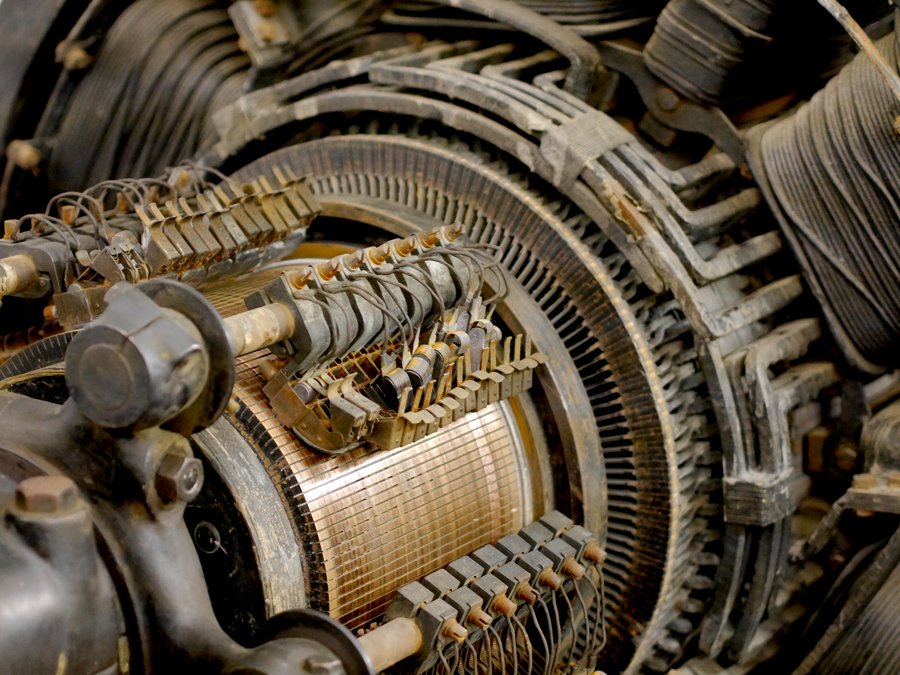
Big industrial machines age in a particular way. The motors get slower to start, the bearings learn the rooms they live in, and the switchgear takes on a kind of rehearsed cadence that newer equipment does not have. Most of the devices on this page are decades old, several are pre-war, and all of them have been running long enough to sound like themselves rather than like a category. The point of this project was to document them properly while they are still in working order.
Across the project, twelve devices were tracked, each in isolation, with the result that none of the recordings need cleaning, gating or noise reduction before use. The full set comes to forty-three stereo files at 192 kHz / 24 bit.
The twelve devices
-
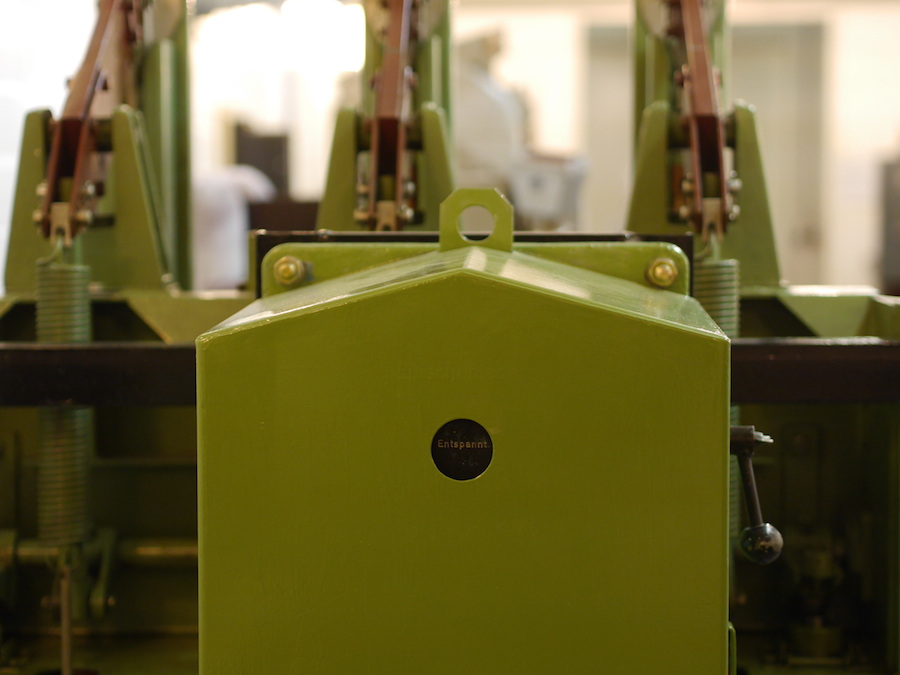
10 kV power switch
A medium-voltage switchgear that closes a circuit with serious mechanical force. The transient is short and percussive, but the air movement and the structural ring afterwards extend the event well beyond the contact moment. The single loudest source in the collection.
-
Pneumatic power switch
Closer to a hydraulic-pneumatic actuator than to the electromechanical switches above. Long-throw movement, strong air content on release, and a metallic seat at the end of travel. Tracked from both air and contact perspectives.
-
Siemens exciter machine, 1945
An exciter built in 1945, the type used historically to feed DC current to the rotor of a larger generator. It runs with a low whine that drifts as the windings warm, plus a layer of slow brush noise. Recordings include cold start, sustained run and run-down.
-
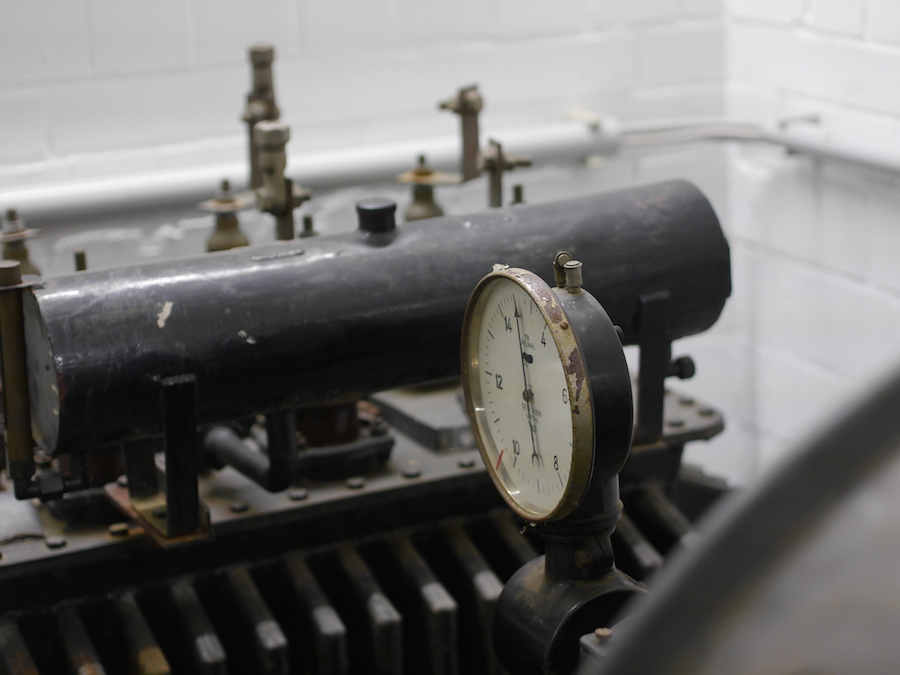
Manual steam machine
Operated by hand, with valves opened and closed in real time. Slow start with mounting hiss, sustained running with a regular mechanical beat, valve bleed-offs and full shut-down. Strong low-end body, captured with both air and contact mics.
-
Gas turbine model
A working scale model of a gas turbine. Smaller in scale than the full-size machines, but with the characteristic spool-up and spool-down profile intact, which makes it useful as a layer for jet, drone and large engine sounds when pitched down.
-
Rotation motor
A heavy rotating motor with audible bearing content and a long, even run. Useful for sustained beds and for anything that needs to feel mechanically alive without dominating the mix.
-
Motorized throttle flap
An electrically driven throttle flap. Short servo movements at varying speeds, with the housing resonance captured alongside the motor itself.
-
Oil atomizer
The atomizer associated with an industrial burner system. A high, hissing spray with low mechanical noise underneath, distinctive enough to stand on its own and easy to layer.
-
Coal dispatcher
A heavy mechanical handler used to move coal. Strong impacts, scraping metal-on-metal travel and the loaded resonance of the housing structure.
-
Ash breaker
A mechanism that breaks up compacted ash. Hard, irregular impacts with abrasive grain, almost percussive in nature.
-
Ash blower
A pressurised blower used to clear ash. Continuous high-pressure air with a metallic edge from the duct, plus the start-up and shut-off transients.
-
Mechanical switches and releases
A set of smaller mechanical events: knife switches, latches, releases and lever throws, captured close. Useful as detail layers on top of the bigger devices.
"If something needs to charge up, power down or shake the walls, these old industrial machines never fail to impress."
Two perspectives per device
Most of the larger machines were recorded simultaneously through two systems. The main perspective is a stereo air pair: two Sennheiser MKH 8040 cardioids in close ORTF, into a Sound Devices 633. The MKH 8040 reaches up to 50 kHz, which matters when the deliverable is a 192 kHz file intended for heavy pitching.
The second perspective, used wherever a machine had strong structural resonance, such as the steam machine, the rotation motor and the bigger switches, is a stereo pair of Barcus Berry 4000 series contact microphones, attached directly to the body of the device. The contact pair captures material that an air microphone cannot reach: the load on the casing, the propagation through the steel frame, the low-frequency body of the event.
Where both perspectives were tracked, both are included in the final files as separate stems, so the air and contact content can be balanced or used independently in post.
- Recorder
- Sound Devices 633
- Air microphones
- 2× Sennheiser MKH 8040, cardioid, close ORTF
- Contact microphones
- 2× Barcus Berry 4000 series, stereo pair
- Sample rate / depth
- 192 kHz / 24 bit
- Useable bandwidth
- 30 Hz to 50,000 Hz
- Total recordings
- 43 stereo files, 12 devices
Cataloguing: UCS and forty languages
The cataloguing took almost as long as the recording. Every file is named according to UCS 8.2.1 and carries more than twenty fields of embedded metadata, written into BWAV, iXML, LIST/INFO and Soundminer chunks: CategoryFull, Category, SubCategory, CatID, FXName, Description, BWDescription, CDDescription, CDTitle, Recordist, Designer, Artist, Manufacturer, Publisher, Source, URL, VendorCategory, ixmlNote, OpenTier, LongID, ShortID, Library, Keywords, TrackTitle, Microphone, Location, MicPerspective, RecMedium, RecType, Track, Version, ISRC.
The descriptive fields (Description, BWDescription, CDTitle, TrackTitle, CDDescription, FXName and Keywords) are translated into forty languages, including Arabic, both Chinese variants, French, German, Hindi, Japanese, Korean, Portuguese, Russian, Spanish, Turkish and Vietnamese, and ship as TSV and XLSX sidecars next to the audio.
How the material is typically used
In post, this kind of source material falls into three buckets. First, anything that needs to power up or power down convincingly: spaceship cores, weapons, large mechanical creatures. Second, room presence and atmospheric beds, where the slow drift of a real running machine adds a layer of life that synthesis tends to miss. Third, transient design: the 10 kV switch in particular has been chopped up for impacts, gun mechanisms and door slams in productions far removed from anything industrial.
"Everything is expertly recorded with the sound designer in mind. The Big Machines library in particular is an absolute goldmine."
Jon Lipman, Sound Effects Editor (The Exorcist, Homeland, L.A. Confidential)"A super useful library. Had to use some of the sounds for a super loud motor that pumps water from a river for irrigation."
Aftertouch Audio (Aliens, The Nature of Things)"SHAPINGWAVES has assembled unique library material that pushes each one of its categories to the next level, very useful for sound designers everywhere."
Wylie Stateman, Sound Designer (Deepwater Horizon, Shrek, Kill Bill 1+2, Tron)The work documented here lives on as the Big Machines sound library, distributed as a 2.1 GB download of forty-three 192 kHz stereo WAV files with full UCS metadata, under the SHAPINGWAVES License Agreement for use in film, television, games and other media productions.